


University of North Carolina Athletics
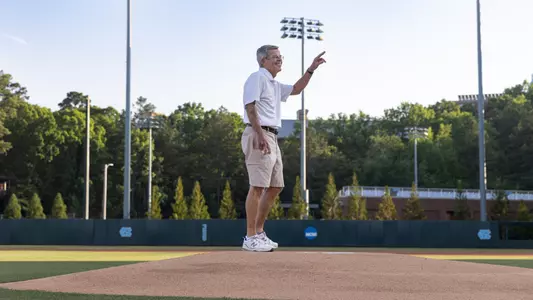
Bray prepares to throw out his first pitch
Bray, So No One Misses It
May 27, 2026 | Baseball
No Man's an Island
Reader, you might have never felt the weight of a collegiate or professional game rest on you.Not just playing, but knowing that one moment could shift everything. A ball slipping past your glove. A swing a second too late. A mistake you might replay long after the lights go out, stuck somewhere between "I should have" and "why didn't I?"
Athletes spend years chasing the opposite feeling. Where the hours of repetition, the corrections, the doubt, all fall into place in a single execution. A throw, a swing, a step that finally feels right.
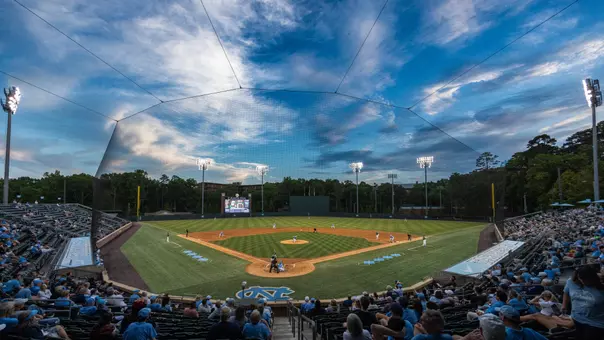
Most of us never live in that space. We sit in the stands instead; pressed shoulder to shoulder, loud, certain, offering up our "expert" opinions rooted somewhere back in our tee ball days. We yell, we laugh, we feed off each other. The crowd becomes its own kind of force; one that lets us feel part of something without ever stepping onto the field.
But look closer. From a distance, the baseball diamond can look like an island. One player in the box. One on the mound. Everything quiet for a split second, like the rest of the world has fallen away.
And yet, no one standing there is ever truly alone.
Because performance has never really been about being alone, instead, belief. The kind that started long before the game and is constant long after it ends. The kind built by the ones who show up; not just in the stands, but in the in-between moments. The ones who steady you when the noise fades.
The crowd can play a part in that feeling, but it's not the whole of it. It's the people who know them. The ones who believe in them whether they're playing well or not; whether they're even playing at all.
And sometimes, that belief has to travel.
For decades, Joe Bray has made sure it does; turning moments on the field into something families can hold onto, something players can carry with them. In a game that can feel like an island, he's spent decades making sure it never is.

Damn Yankees
When you're someone who leaves a lasting imprint on a program (its players, its families, its sense of memory) it doesn't take much for a community to decide it's time to honor you.So when that moment came, Bray wasn't behind the lens where he'd spent the last nearly 30 years. He was standing in front of it. On the mound. On the field. The kind of setting where so many of his own memories had been made.
"I felt like I was a kid again," he said.
And to understand why that moment mattered, we have to go back to when Bray was one.
It starts in Siler City, N.C. Small, steady, the kind of place where everybody knows everybody, and summer feels like it stretches out forever.
Bray's father, Max Bray, owned a camera shop in Asheboro; a World War II veteran, who had landed on D-Day. His father would go on to work as an accountant but photography never really left him.
"My dad was really into photography," Bray said. "He just loved it."
Max was sharp-edged, plainspoken, the kind of man who didn't waste words and didn't hide behind them either. His mother, Vera Bray, was the opposite in ways that balanced their parenting; gentle, steady, attentive to the quiet parts of life.
"My dad would let you know how he felt," Bray said. "But my mom.. she just loved everybody."
Between those two, Bray grew up learning how to pay attention. Not in any formal way. Just the habit of noticing things others might walk past. Siler City filled in the rest—the kind of place where mornings started early, because that's when everything began.
"We'd get to school an hour early just to play baseball," he said.
1950s America; Sock hops in gymnasiums, drive-ins after dark, radios on in kitchen windows while kids stayed outside until the streetlights came on. Baseball was everywhere in it. And at the top of it stood Mickey Mantle. Mantle wasn't just a player, he was the guy. Power, charm, flaws and all. The kind of figure kids and adults alike watched, studied, and tried to become. Bray was one of those kids.
"I thought he was God," he laughed.
His bedroom walls said it plainly; posters of Mantle looking out over a small-town room, turning four walls into something bigger than they were. And when he got the chance to go to Yankee Stadium as a child, it all expanded even further.
"I remember Mickey hit a double that day," Bray recalled. "My dad was in New York on business, and he took me with him. I just remember thinking, this day never ends. I'm in Yankee Stadium. I felt like I was in heaven."
It wasn't a turning point. Not yet. Just a kid in the stands, watching a game he already loved become something real in front of him.
Even then, baseball wasn't something he was trying to become, it was just something he was growing up inside of.
And even when things changed, that never really left.

Catch Up, Carolina!
In the 80s, UNC hired a damn good IT specialist.Not good, damn good. And if you knew Bray, if you really understood the kind of impact he's had, you'd say the same. The thing is, you might not know that impact at all if all you knew was Joe Bray. He's unassuming like that. Not the kind of person who walks around announcing what he's done. More likely, you hear about him from someone else when you realize just how much of Carolina runs through him.
And that might sound like a stretch, maybe even a little ridiculous. But stay with me.
Bray's influence might be one of the few times Carolina wasn't playing catch-up; they hired someone who was already a few steps ahead of where everything was going.
Long before most programs understood what it could be, he helped build Carolina's digital presence from the ground up.
He created what would become GoHeels.com. He helped build the early framework for the Student Center, the platform students still use to keep up with their academics. He built systems that changed how fans, athletics, students, professors—everyone—stayed connected.
He'll tell you it wasn't a big deal. Just something that needed to work.
But it did more than work. It reshaped access. It made the distance smaller.
There is so much to say about that work. But its impact shows up most clearly in something simpler; in how people could experience Carolina athletics.
Because in collegiate athletics at the time, unless you were in the stands or watching on TV, there wasn't much else. No constant updates. No immediate connection. If you weren't there, you missed it. Simple as that. Bray didn't love that. So in 1995, he started showing up to change that.
Football practices in the summer heat, conditioning when no one else is around. The long stretches that don't make it into recaps.
"We weren't allowed to go home, and we'd have to be here all summer working out and running conditioning," former UNC football player Brian Chacos remembered.
"And who would be out there running conditioning also with the football team? Joe Bray…just the quintessential Carolina guy."
He wasn't assigned there in the way people usually mean it. He was just…there. Volunteering. Camera up. And over time, that presence started to mean something.
"As a freshman, you don't really know who he is at first," Chacos said. "Over time, you see him around, start asking questions, and eventually, you just know Joe," Chacos said.
At first, it was football. But somewhere along the way, he started drifting across the street to Boshamer Stadium. At first just games. Then practice. Then everything in between.
This is where it changes. Not just what he was doing, but why it mattered. Because Bray wasn't just taking photos, he was noticing people. He started learning every name; writing them down in a small spiral notebook; and matching faces to moments so nothing—and no one—got lost in the blur.
"He'll take hundreds of pictures," assistant AD Michael Beale said. "But he logs them. Makes sure he knows exactly who's in them."
And then he did something no one else was really doing at the time; he sent them out. Not to media. Not for attention…To families. Parents who weren't there. Who couldn't be there. Who had just dropped their kid off and were left trying to imagine what their days looked like now.
"He was documenting things they never would've seen," Beale said.
A swing. A stretch. A laugh in the dugout. The kind of moments that don't feel big until they're gone.
"It wasn't about the games," Beale said. "It was about everything else." And the people on the other end felt that.
"My mom would get the images and she'd say, 'Mr. Bray sent us more pictures today,'" sophomore pitcher Ryan Lynch said.
"It's really nice for a lot of parents, especially those first couple of weeks. They've just sent their kids off to college, and it's their first time seeing them in the uniform. A lot of it is stuff they can't be at, or don't have the time to get to."
Fall scrimmages. Random practices. In-between days no one thinks to document. Except he did.
"He's always there, he's always positive," Lynch said. "Even the things no one else with cameras come to."
And when he's there, he doesn't just stay behind the camera.
"He makes it a point to know everyone," Lynch said. "He asks about your life, your family… what you're into outside baseball."
That's the part that sticks.
Because over time, he stops being 'the guy with the camera'. He becomes someone you expect to see. Someone reliable, someone who cares. For players, that presence builds quietly. For families, it means something immediate.
Parker Haskins' family wasn't always able to make it to Chapel Hill. But they still saw his experience unfolding.
"They'd get the photos," he said. "And it made them feel like they were still part of it."
Not watching from a distance, but connected, which is a different thing entirely. Even the people leading the program began to notice.
"I didn't realize at first how much time he was putting into it," former head coach Mike Fox said. "Then I found out he's sending pictures to all the parents… and I thought—yeah, that's Joe."
Because it wasn't about recognition, It never was.
"He's doing it because he thinks it'd be cool for a kid's mom to have that picture," Fox said.
And that kind of thinking; done over years, over teams, over hundreds of players turns into something bigger than you expect. And maybe that's where this all starts to land. Not just in what he did. But in what it meant.
Because for a long time, Bray was creating something for other people; without fully knowing what it would feel like to need it himself.
After his father passed, Bray went through what was left behind. Boxes. Photographs. Fragments of a life that had always been there, but not fully spoken aloud. His father had kept a visual record of his time serving in World War II.
Not the grand version of war. Not the headlines, but the in-between. Biking and driving in France; Soldiers becoming something like family. And then something else.
"I found what looked like a military medal," Bray said, "and then I found the yellow printout… and he had won the Bronze Star for gallantry from June 6 through July 7, 1944. He never told me. Never told me."
What stayed with him wasn't just the discovery, It was the experience of it. He wasn't there, but suddenly through those images, he was closer than he'd ever been. He could see it. Feel it. Step into moments of his father's life that had never been spoken out loud. The distance didn't disappear, but it changed. Because without those photographs, those moments are gone; and with them, a version of someone you love that you'd never get to know.
Which is what makes what he built at Carolina hit a little differently.
All those years weren't just about documenting a team; they were about giving people a way in. A way to see. A way to feel close. A way to hold onto something they weren't there to witness. And maybe he didn't have the language for that at the time. Maybe he didn't need to. But standing there, flipping through those boxes, he, without realizing it, understood the feeling more clearly now.

Bray Receives His Flowers
Reader, why is it that some people make it so easy to just exist?To be around them without feeling the need to perform. No pressure to fill silence. No need to be anything more than exactly who you are that day.
And then you notice it, usually only after it's gone, how rare that feeling actually is.
Joe Bray is that kind of person.
Which is almost ironic, considering he's usually holding a camera; the one object that tends to make people stiffen, straighten up, become hyper-aware of themselves. And yet, around Bray, that instinct fades. People settle. They stay themselves.
Mike Fox understood that better than most. Especially on the hard days, through mornings when the weight of a weekend hadn't worn off yet. Through long days when everything felt like it was on the line. Fox remembers those, too.
"You come in on a Monday morning, you've gotten swept… you've got to keep going," he said. "You can't show any of that."
And then Bray would walk in.
"He'd poke his head in, 'How you doing this morning?'" Fox said. "He just had a way of being like it's all good."
No critique. No second-guessing. Just someone grounding enough to shift the room without trying to.
"There were mornings where he was who I needed to see," Fox said. "Not the assistant coaches… not anybody else. Just somebody who's got your back no matter what."
And that wasn't something Fox only felt.
"It doesn't take you very long to realize this is a really, really good human being," he said. "Soft-spoken. Loves Carolina. Loves the kids… you start off friends, then good friends, then great friends—then it's someone you can count on."
That kind of presence doesn't come from nowhere. It shows up in the small things.
In the way he asks, "How's school going?" and actually means it. In the way he keeps up with players long after they leave Chapel Hill. In the way he values who they are becoming just as much as what they do on the field.
No cameras. No audience. No reason, other than care. The same care he pours into the relationships—he pours into the work.
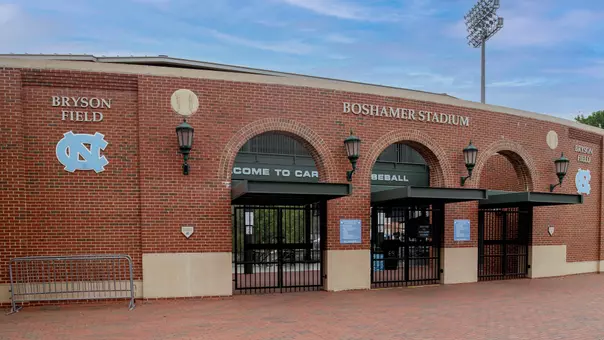
And on May 11, 2023, at Boshamer Stadium, it came back to him.
Behind the scenes, Chacos (now major gifts director for the Rams Club) and Dawn Williams worked with his daughter, Christy, along with other loved ones, to develop an idea: naming the Boshamer Stadium photo well after him; a space he had occupied for years, now carrying his name.
It meant fundraising. Outreach. Coordination.
But once people heard who it was for, it moved fast.
"As soon as we brought the idea up… it was unanimous—this is a no-brainer," Chacos said. "Everybody loves Joe… he represents what's so good about college athletics."
Former players. Families. Donors. People who had passed through the program years ago and still felt something when they heard his name.
"It wasn't one or two people," Fox said. "It was everybody."
They showed up for him the same way he had shown up for them. When Fox reached out to former players, the responses poured in; More than a hundred former players sent messages back. "Just telling him how much they love him… it's about as powerful as it gets," Fox said. "They were all from the heart."
That Thursday night against NC State felt like any other to Bray. Warm May air. First game of a series. Routine. Bray arrived the same way he always did; camera ready, moving through the familiar rhythm of a game day. No idea what was waiting.
Christy kept him moving, steering him away from the patio where loved ones had gathered. "I was so afraid the surprise would somehow be ruined," she said. "I spent days in advance coordinating our movements on that day down to the minute."
And still, he had no idea. Not until she led him around the corner; And suddenly, there it all was.
"We walked out, and there's all these people I knew," Bray said. "She said, 'Daddy, this is for you.'"
People he recognized. Voices he knew. A space that had been filled with his work for years, now filled with the people it had touched.
"He was obviously very emotional," Chacos said. "It was a very well-deserved recognition."
Before he could even fully sit, another surprise followed.
"You're throwing out the first pitch," Beale told him.
No time to overthink it.
A few rushed minutes warming up beside the dugout. Family nearby. His grandsons watching.
"I felt like I was a kid again," Bray said. "Just standing there playing catch, I really felt like I was back in Little League."
Then, the walk to the mound.
"There were probably a couple thousand people in the stands… and I have never been more relaxed in my life."
He drew back—and let it go.
"And I threw a strike."
He turned to his family, almost in disbelief.
"My grandson said, 'Pop Pop, how'd you do that?'" Bray said. "I told him, 'I don't know.'"
And just like that, it became one of those moments you don't touch again.
The kind you leave exactly as it is.
But the night wasn't over, then came the messages.
"I've got these two books… over 100 former players recorded messages," Bray said. "Every time I try to watch it, I just start crying."
Fox knew that would happen.
"I told him… you might need some Kleenex," he said.
One message after another.
Different years. Different teams. The same feeling. Gratitude. Respect. Love.
And maybe that's the clearest way to understand it.
Joe Bray spent years making sure other people didn't miss the moments that mattered.
On that night, for once—He didn't miss his own.


Players Mentioned
RHP
/ BaseballUNC Baseball: Pre-NCAA Regional Media Availability
Thursday, May 28
BASE: Pre-Chapel Hill Regional Press Conference
Thursday, May 28
UNC Baseball: Offensive Explosion Sends Tar Heels to ACC Title Game
Sunday, May 24
BASE: Offensive Explosion Sends Tar Heels to ACC Title Game
Sunday, May 24