


University of North Carolina Athletics
October 22, 2026 | Football, Student-Athlete Development
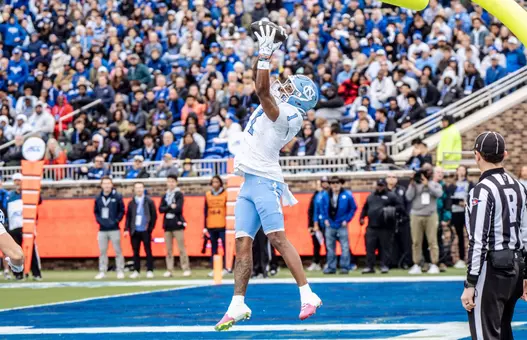
Two days earlier, Jelani Thurman had caught five passes for 50 yards and two touchdowns, and Benjamin Hall had carried the ball 10 times for 36 yards on a rainy day in Kenan Stadium against Notre Dame.
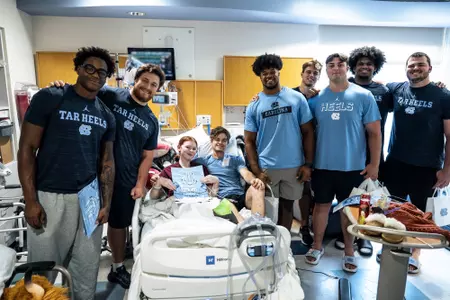
Now on Monday afternoon, 300 yards away from the playing field, Thurman, Hall and eight of their teammates are making their rounds on the fifth, sixth and seventh floors of UNC Children's Hospital. They go room to room, visiting young patients being treated for a wide variety of illnesses—cancer, heart disease, gastro-intestinal issues, burns, general surgery and other afflictions.
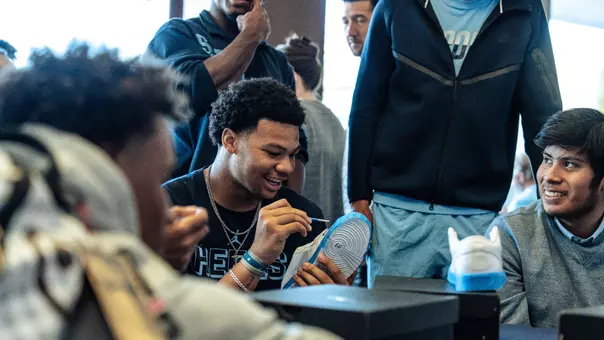
They hand out gifts—individually signed team posters and bags filled with boxes of Crayons, cans of Play-Doh, card games, kids' sunglasses and Carolina blue bracelets and lanyards.
Most of all, they distribute smiles and good tidings to a universe of children and parents facing severe challenges.
"This does more for us I think than it does for the kids," Hall says. "It keeps us grounded, reminds us how blessed we are, how fortunate we are. There are so many different stories, each one touches you in a different way. It's a good use of our time."
"Seeing us is great for the kids, but it's important for the parents and the families just as much," adds Thurman. "The parents go through a lot. We're lucky. We get to play football. Some of these kids, they can't get out of bed right now. If we can help the kids and their parents get through another day, we've done something good."
Center Christo Kelly is one of the Tar Heels' leaders and is actively involved in all elements of the program's community outreach efforts—from the Children's Hospital to stuffing grocery bags for the TABLE food bank to visiting middle school classrooms. He points to his Carolina blue jersey with the No. 56 and the mandate that carries.
"Visiting these kids reminds you of the impact you have as a student-athlete and a Tar Heel, the power that carries and the responsibility we have while we're here and we put on this jersey," he says. "Something as small as smiling and having a conversation can make people's days. It's incredibly rewarding part of the culture created here and established here. I am really grateful for the group we have. It's an awesome experience."
As they make their way around the wards, Tar Heels greet the young patients with fist bumps and high-fives. They mug for photos. They sing Happy Birthday to two youngsters celebrating special days. They ask the kids if they heard the noise from the stadium that weekend and encourage them to tune into TV the following Saturday, when they'll play at Pittsburgh.
They leave each room with a word of encouragement: "Keep up the fight, little man."
"Seeing the players give my son some hope, it's encouraging," says Tiffany Tait-Moss, whose son Isiah is a patient. "These players are a blessing. This means more to us than you can imagine."
"It's a big moment, it made our day," adds Fred Gore, whose son Josiah is a patient. "Please tell them to keep it up. It does so much good."
The tradition of football players making hospital visits began at least in the early 1980s when Dick Crum was the head coach. For many years the visits were organized for Friday afternoons before home games, days when there was no practice, meetings or travel.
"You walk out with such an appreciation for life," says Richard Applebaum, a mid-1980s offensive lineman. "Some days it was just me and Carlton Bailey making the visits. But it was important."
Corey Holliday was a receiver in Mack Brown's first recruiting class in 1988, and the Friday hospital visits were part of his fall Friday routine for four years. Brown's administrative assistant, Becky Medford, organized the visits and accompanied the players each Friday. Holliday was gratified years later when his son, Christopher, joined the team and took to the children's visits on his own without any prompting from his dad.
"It was something you looked forward to every weekend," Holliday says. "The hospital visits started game day weekend for me. Once I got to the hospital, it was 'game-on.' Everything else was out the window. I was going to the hospital to see the kids, try to add a little light to their lives and then get on the bus to the hotel. The next day was game day. I loved the routine. We could bring a smile to their faces and make their day a little better."
David Secrest was a kicker from 1993-97 and brought a unique level of hospital and health-care perspective as his father, Jack, was a urologist in Shelby. Secrest made dozens of hospital visits over his five years as a Tar Heel and today is on the board of the Atrium Health Foundation in Charlotte.
"I was comfortable walking into a hospital, into a patient's room," he says. "Some of the guys who were the fiercest on the playing field were a little timid in that environment. I was happy to take something of a leadership role in that area. I loved it and parlayed that into a passion for health care service work that remains strong today."
Every Tar Heel coach since then has carried on the tradition, with slight adjustments through each era. Coach Bill Belichick has supported the outreach but suggested it might work better on Monday during the season, the players' typical day off. Now it's a standing date early every Monday afternoon for Briana Singleton, a member of the Student-Athlete Development staff, to coordinate a visit from around a dozen Tar Heels.
"This has been a wonderful tradition over many years," says Beth Bailey, a volunteer services coordinator at UNC Children's Hospital. "I think the proximity of the hospital and Kenan Stadium make it a natural fit. The players will joke to the kids: 'Hey, that noise you hear on Saturday is me scoring a touchdown,' things like that. The kids, their parents and the hospital staff look forward to seeing that group of football players making their way through the hallways."
Saturday's game against Syracuse has been designated as the Cancer Awareness Game, and much attention has been directed over the last several years on these occasions to Tylee Craft, the Tar Heel receiver who battled cancer for four years before his passing in 2024.
Carnell Warren is a freshman receiver from Bluffton, S.C.., and had heard about Craft, a fellow Sandlapper from Sumter.
"Visiting these kids is a blessing," Warren says. "You never know what can happen in life. Like Tylee—one day playing football, the next day he has cancer. With me being healthy and able to play football, giving a little something back to the kids is one of the most significant things I have ever done. God has blessed us with the ability to play football. You never take that for granted."
Chapel Hill writer Lee Pace (Carolina '79) has written about Carolina football under the "Extra Points" banner since 1990.

Players Mentioned

Running Back
/ Football
Offensive Line
/ Football
Tight End
/ Football
Wide Receiver
/ FootballThursday, October 22
Tuesday, October 20
Tuesday, October 20
Tuesday, October 20