


University of North Carolina Athletics
November 26, 2026 | Football
Carolina football has had three eras of season-ending rivalry traditions.
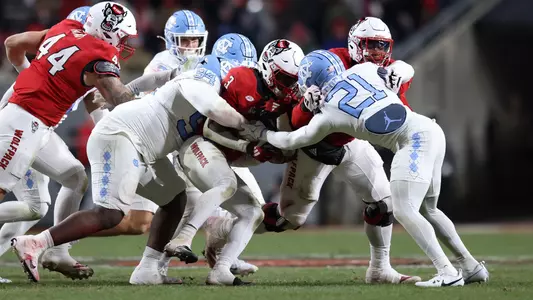
There's the current arrangement that began in 2014 with the Tar Heels facing N.C. State the Saturday after Thanksgiving (and on Friday on several occasions), the result of an ACC initiative to align its final regular-season weekend to feature marquee matchups ahead of its conference championship weekend.
Before that beginning in 1951, the Tar Heels faced Duke the Saturday before Thanksgiving when schedules were 10 or 11 games and didn't require that 12th game to extend past the holiday. The rivalry was a fitting climax to the season with the winner taking local bragging rights and the Victory Bell. The Carolina-Duke game was given thought as being the Tar Heels' "Rivalry Week" slotting in 2014, but Duke administrators begged off knowing that the years it hosted the game would fall when a majority of the Duke's out-of-state student body would be flung far and wide.
And the first half of the 20th century belonged to the Virginia rivalry. That was the game that stretches back to the beginning in the late 1800s.
"The Carolina-Virginia game is to the South what the Yale-Harvard game is to the North, and with this idea in view perhaps can be understood the intense and enthusiastic interest which this game always arouses," noted a 1906 passage in The Yackety Yack, the Carolina student yearbook.
And the Tar Heels vs. Cavaliers game provided the very impetus behind launching the idea just over a century ago that Carolina needed a new football stadium. Kenan Stadium, wrapping up its 100th year of being the Tar Heels' home when the Wolfpack comes to town Saturday for a noon kick-off, owes its very roots to that Carolina-Virginia game.
Carolina fielded its first football team in 1888, and the Carolina-Virginia game over three decades was normally contested in Richmond over Thanksgiving weekend, but by the end of World War I the schools switched to a home-and-home arrangement. The first home field for the Tar Heels was Emerson Field, which was built in 1914 and located on ground now occupied by the UNC Student Union and Davis Library.
Emerson Field had 2,400 permanent seats that could be augmented by temporary bleachers. When Virginia came to Chapel Hill in 1925, newspaper accounts said the venue was overrun with some 16,000 fans. Nearly 200 newspaper reporters were expected for that game, and university officials erected a stand on the south side of the field that would accommodate fifty reporters, with the rest having to sit in the stands.
The Durham Morning Herald during this mid-1920s juncture said the school was "in dire need" of an adequate facility, and another newspaper story cited editor Louis Graves of the Chapel Hill Weekly with creating "agitation" with an editorial decrying the school's inadequate playing venue. The solution was a new and larger stadium for football, leaving Emerson Field for baseball and track.
A group of 18 university alumni met in May 1926 at the Washington Duke Hotel in Durham, among them the power brokers whose names were already or later would be on buildings, foundations and roads around Durham and Chapel Hill—Hill (John Sprunt and George Watts), Morehead, Carr, Blount and Umstead.
The new venue would not only be the football Tar Heels' home but could serve as an outdoor convocation center for pageants and concerts. It would be called "The University Stadium," and one of the Mr. Hills said he thought there were 50 men in the state willing to give $5,000 each to make it happen.
Two possible configurations were outlined to the initial committee as prepared by Atwood and Nash, the engineering and architectural firm handling new building projects on campus. The first design would seat 33,500 in a one-level horseshoe and cost $475,000 to $500,000. A smaller option seating 24,000 without end-zone seating would cost $355,000.
The committee published a prospectus and began soliciting "subscriptions" to fund the stadium, its key selling point that with a contribution of $100, benefactors could lock in seat locations for 10 years (provided, of course, they purchased the tickets at regular prices). Those particularly generous and donating $5,000 or more would have their names permanently inscribed on bronze tablets to be displayed at both main entry gates on the north and south sides of the stadium.
The committee had raised approximately $28,000 within weeks when the prospectus found its way to the New York office of William Rand Kenan Jr., a 1894 graduate who had been a halfback during his collegiate days before developing significant business interests and achieving success in chemicals, power, railroads and hotels.
Kenan read the prospectus and was ready to support the venture as others were doing.
"I am interested in this matter," Kenan wrote to the treasurer of the Stadium Committee on June 29, 1926, further asking for a list of contributors of more than $1,000.
Kenan visited Chapel Hill and was shown the prospective site by UNC administrator Charles Woollen—a wooded parcel just south of main campus.
"The favorable terrain makes possible a countersunk stadium with ends that through proper treatment, melt into the slopes of the hillsides, leaving through the open ends the beautiful vista of the valley," Woollen noted. "In such a forest setting, the open-ends type will have more beauty and finish than the 'horseshoe' type."
Kenan quickly decided that he would underwrite the entire venture and he made the
offer in the office of University President Harry W. Chase. The Stadium Committee voted quickly and unanimously to allow Kenan to pursue this tack and soon approved a 24,000-seat venue that Kenan would fund at a cost of $275,000.
"In a natural ravine in the forest just south of the southern boundary of the campus, work is actively progressing on the stadium, known and designated as Kenan Memorial Stadium," read a resolution ratified in January 1927 by the UNC Board of Trustees.
Construction continued at a furious pace the rest of 1927 with the hope of opening the venue in time for the season-ending Virginia game. Kenan visited during the fall after a majority of the work had been completed and raved to Woollen: "The drawings and pictures made me satisfied that things were going along well, but they could not give an adequate idea of the setting and color effects. So I was not prepared to find the stadium as beautiful as it is."
Twelve days later on Thanksgiving afternoon, the official christening and dedication game was held against Virginia. An estimated 28,000 spectators jammed the newly minted facility, and WPTF radio in Raleigh orchestrated the first live broadcast of a sports event in the state. Fittingly, the Tar Heels won the game, 14-13.
"The University of North Carolina, leading and pioneer educational institution of the South, now possesses the finest example of gridiron architecture in the country," The Tar Heel proclaimed the day of the game.
Years later, Thomas S. Kenan III of Chapel Hill (UNC '59) marveled looking at late-1920s postcards showing Kenan Stadium.
"It's amazing when you look at the woods around the stadium," says Kenan, who grew up in Durham a very distant and much younger cousin of William Kenan. "These are wonderful pictures. Look at all those beautiful trees. That's what Mister Kenan loved. He always talked about the trees. If a tree died, he'd be talking to someone about replacing it."
So important was that wooded envelope around the stadium that over the 1900s the myth evolved that the Kenan family stipulated that no part of the stadium ever rise above the tree line. Athletic Director John Swofford went to Frank Kenan, Tom's father and the family patriarch through the late 1900s, to ask about that when he needed to install permanent lights and a new southside press box in 1988.
"It was just lore, but good lore," Swofford said. "Frank said there was no such restriction. He said for us to do what we needed to do keep up with the times."
Certainly, the demand for new university infrastructure—classrooms, dormitories, hospitals, parking and the like—has pinched the facility and the woods around it over its century of existence. But today one can stand in a wooded thicket less than 50 yards from the gate and have to squint through the trees to see the structure. Kenan Stadium now as it always was—one of one in the world of college football.
Lee Pace (Carolina 1979) has been writing about Tar Heel football under the "Extra Points" banner since 1990 and is the author of a book about Kenan Stadium. A centennial edition of "Football in a Forest" will be published in 2027.


UNC Volleyball: Tar Heels Fall to #4 Louisville in 5 Sets
Wednesday, November 25
Coach's Corner with Bill Belichick - November 25, 2026
Wednesday, November 25
WBB: Post-Gardner-Webb Press Conference - Nov. 24, 2026
Wednesday, November 25
UNC Women's Basketball: Brooks Rains Threes in Win vs Gardner-Webb, 93-33
Wednesday, November 25