


University of North Carolina Athletics
November 11, 2026 | Football
Today Graham Court Condominiums are comprised of two century-old brick buildings sitting in the leafy McCauley Street neighborhood just west of the Carolina campus. Bebe Johns Fox was a young girl living there in the early 1940s, when newspapers were full of coverage of World War II and Chapel Hill was invaded by thousands of young men preparing to go to battle.
One of the newcomers to town made quite an impression.
"I'll never forget that handsome Paul Bryant, who I passed one morning as he was walking from his apartment toward his car parked on McCauley Street," Fox remembered years later. "He was dressed in his navy-blue uniform, including the official hat and longish overcoat. We nodded good morning. Was this then-kid ever impressed. I am 74 years old and the mental visual is still clear as a photograph."
Author Jon Meacham wrote of an 18-year-old George H.W. Bush arriving in Chapel Hill in the summer of 1942, bunking in Lewis Dormitory Room 317 and one day entertaining his girlfriend, Barbara Pierce, who was visiting from college in Charleston, S.C.
"The two were in their own world," Meacham wrote in Destiny and Power. "They had a sandwich and walked the campus, winding up at the university's Kenan Stadium in a grove of pine trees about a mile away from the Carolina Inn. A sudden storm drove them into the canvas-covered press box. 'We laughed at everything,' Bush wrote to his mother."
Bryant, who would later be known as "Bear" during his legendary coaching career at the University of Alabama, and Bush, the 41st President of the United States, were two of the young men dispatched to Chapel Hill for Naval Pre-Flight training.
As the United States entered the war against Germany and Japan following the Japanese attack on Pearl Harbor in December 1941, Chapel Hill became a key cog in America's preparations. The university was one of four sites established for the physical conditioning of naval cadets before they began flight training. The Navy Pre-Flight School operated at Carolina from May 1942 to October 1945. Every three months, a group of over 1,800 men took classes in sports and basic military science.
It's a fascinating story to remember as Carolina celebrates Military Appreciation Day Saturday when Louisville comes to Chapel Hill for a 7 p.m. ACC contest. On the same field in Kenan Stadium where the Tar Heels and Cardinals will do battle, naval cadets began their daily training regimen with group exercises and calisthenics.
"It's the greatest thing that happened to Chapel Hill since Davie founded it," said Orville Campbell, the public relations officer for the Pre-Flight School and later publisher of the Chapel Hill Newspaper.
After their early morning exercises in Kenan Stadium, the cadets received rigorous academic instruction in military science and engaged in boxing, swimming, baseball, football and basketball. The Navy built a barracks, a pool, a gymnasium, a canteen and an obstacle course for their cadets, all of which it gave to the university at the end of the war (Kessing Pool remains in operation today next to Carmichael Arena). There was also some free time, and entertainers like Ronald Reagan, the Jimmy Dorsey Orchestra and Kate Smith came to campus to entertain.
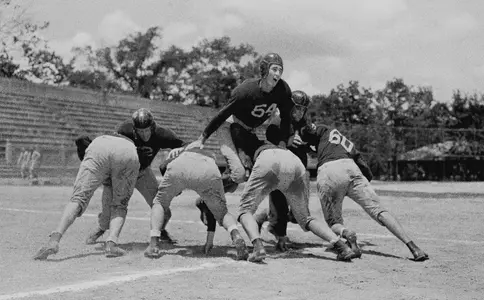
The program also spawned teams nicknamed the Cloudbusters, who represented the Chapel Hill Pre-Flight School in football, basketball and baseball.
During the autumns of 1942, '43 and '44, the Cloudbusters football squad played a full schedule alongside the official Tar Heel teams (though never against each other). In addition to Bryant, future notables visiting Chapel Hill in either coaching or playing roles included Otto Graham, Johnny Vaught and Gerald Ford.
Ted Williams and Johnny Pesky came to Chapel Hill to play on a Cloudbusters baseball team, and officers including Frank McGuire (later the Tar Heels' head coach and winner of the 1957 NCAA championship) and John Wooden (future UCLA head coach) drilled cadets on the hardwood basketball courts in Woollen Gymnasium.
"Franklin Street in downtown Chapel Hill was teaming with Olympic athletes, world-champion boxers and wrestlers, professional football players and college basketball stars wearing military khakis," says Anne Keene, author of a book about Ted Williams and the Cloudbuster baseball team. "An entourage of major league ballplayers, training to become pilots, frequented the soda counter at Sutton's Drugstore and Village Theater matinees."
While the pre-flight program brought thousands of officers and cadets to the Carolina campus, one interesting story worked in reverse.
Jim Tatum grew up in McColl, S.C., and came to Carolina, where he was a football tackle (lettered 1932-34) and baseball catcher. He served as freshman football coach from 1939-41 and as head coach for one year, 1942, when incumbent Ray Wolf was called into the service. The Tar Heels posted a 5-2-2 mark that year.
"Only 28 years old, Tatum is one of the youngest head football coaches in the nation and with only mediocre material produced a fighting eleven that tied two 1942 bowl elevens, Fordham and Duke, and lost only to State and Tulane, which was rated sixth in the nation," said The Daily Tar Heel.
Immediately after the 1942 season finale against Virginia, Tatum resigned to enlist in the Navy and was assigned to the Iowa Pre-Flight School. He was an assistant coach there under Don Faurot (inventor of the Split-T offense) and Bud Wilkinson. Tatum frequently credited his time in Iowa City as his football epiphany. He mastered Faurot's innovative, wide-spaced offensive scheme and took it with him to the civilian coaching ranks after the war as head coach at Oklahoma, Maryland (winning the 1953 national title) and later when he ran the Tar Heels' program from 1956-58.
It was a remarkable period during a watershed period of American history.
Keene unearthed a letter that Bryant wrote in 1981 to Don Kepler, who was on the same pre-flight coaching staff in 1942: "Chapel Hill brings back many fond memories and some I'll cherish forever. At the time I thought I was having a tough go, but as it turns out I was having the best time, making more take-home money and enjoying everything more than any time in my life."
Meanwhile, the varsity team had three head coaches in three years due to service-oriented turnover. By 1945, however, Carl Snavey had been installed as head coach and future Hall of Fame players like Charlie "Choo Choo" Justice and Art Weiner had joined the team, setting up a four-year period of three bowl teams and a national title contender.
"We feel as a mental and physical conditioner, football is making an important contribution to the war, and that is would be a serious mistake to abandon this sport now, even if the contests have to be confined to our state or to our own campus," Athletic Director Bob Fetzer said.
Chapel Hill writer Lee Pace (Carolina '79) has written about Carolina football under the "Extra Points" banner since 1990.



Thursday, November 12
Thursday, November 12
Thursday, November 12
Wednesday, November 11