


University of North Carolina Athletics
Photo by: Jeffrey A. Camarati
November 14, 2026 | Men's Basketball, Featured Writers, Adam Lucas
Too many breakdowns doomed the Tar Heels against Georgia.
By Adam Lucas
Before Carolina had even inbounded the ball, Michael Malone had already furiously turned to his bench.
"Clip that!" he barked.
There were just over five minutes left in the first half of Friday night's game against Georgia, and Malone's Tar Heels had just given up a wide-open three-pointer to Marcus Millender. It would ultimately be one of 14 trifectas made by the Bulldogs, but it wasn't the three-pointer that had the first-year UNC head coach hot.
Instead, it was the play that led to the three-pointer. Terrence Brown had stripped a Georgia dribbler and created a loose ball in the paint. The ball rolled between four Tar Heels, and one ultimately tried to bend at the waist and pick it up. But around that same time, Georgia's Freddie Dilione V threw himself on the ground to secure it. Safely in possession, he tossed it out to Millender, who swished a wide open three-pointer that gave Georgia a five-point lead.
Malone showed the clip to his team at halftime with a very simple message: "It was an example of who wants the ball," he said after the game, still fuming about the play. "They won that 50-50 battle and got a wide open three off it."
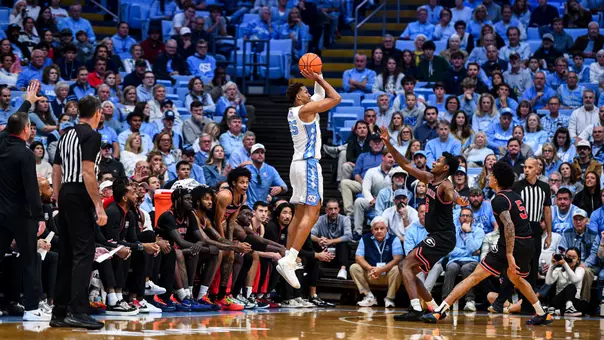
That was part of the story of Georgia's 78-70 win at the Smith Center. The Bulldogs shot better and more wisely, as they hit 14 three-pointers while watching Carolina hoist a school record 38 and make just nine. They executed more effectively down the stretch, closing on a 27-10 run over the final 10 minutes of the game and 15-4 over the final 4:20 (the Heels scoring four points over the final 4:20 tells you what kind of offensive finish it was for the home team).
"The details, the details, the details," Malone said. "We didn't have attention to detail or gameplan discipline or personnel discipline. In a close game that will bite you, and tonight it did."
What does that mean, gameplan discipline? It means given the UNC rebounding shortcomings over the first three games of the year, Carolina was well aware Georgia would repeatedly try to get second chances.
For the first 30 minutes of the game, given the personnel limitations, the Heels did a credible job on the backboards. With just over nine minutes left, Georgia had only five second chance points, a manageable number.
But then things—the details—fell apart. The Bulldogs piled up 10 second chance points during a 6:56 span. Not coincidentally, the stretch saw the game go from a six-point Tar Heel lead to a one-point Georgia advantage. The key sequence, and one that still bothered Malone after the game, came when the Heels allowed James Scott to rebound his own missed free throw, then permitted Blue Cain to rebound the ensuing missed three-pointer and then watched as Scott slammed home Cain's miss.
"There are certain plays in a game that will drive a coach absolutely bonkers," Malone said. "A free throw box out is one of them. You cannot allow a team to rebound a free throw after a missed box out. That's a lack of discipline and physicality."
And those types of plays are ultimately what decided the game. Since the very first day of practice, Malone has consistently talked about building the types of habits that win games.
On Friday, Carolina simply didn't have enough of them. It's not a fatal flaw; this is mid-November in a very long season, and if the errors are corrected, we'll look back at the Georgia game as a necessary teaching point. Without the benefit of knowing the future, though, all we know for certain is the mistakes were decisive on this particular night.
"It's something I've been telling our team for a while now," Malone said. "At the end of close games, your habits come out. Do you have good habits or bad habits? Whether it's a missed free throw box out, a turnover, or not running off a shooter from the three-point line, we just had too many breakdowns at the end."
Players Mentioned

G
/ Men's BasketballSaturday, November 14
Saturday, November 14
Saturday, November 14
Saturday, November 14