
University of North Carolina Athletics
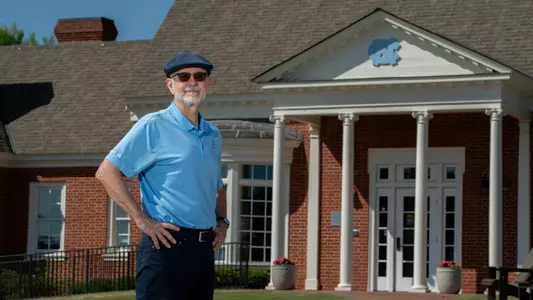
Photo by: Jeffrey A. Camarati
Wilkinson Retires As Finley Professional After 33 Years
April 28, 2026 | General, Finley Golf Club
When Michael Wilkinson began working in the golf shop at the University of North Carolina's A.E. Finley Golf Course, the 18-hole track was 30 years old. Built several years after the end of World War II, the course was a result of Mr. Finley's generous funding and his vision to provide an accessible playing opportunity for Carolina students, faculty, staff and community.
For the last 33 years, "Wilkie" (as he is more typically and affectionately known) has truly been a constant at Finley, whether behind the counter in the golf shop or teaching one of the thousands of lessons he has given on the driving range and practice areas.
During his tenure, the course itself has undergone two major renovations, Tar Heel coaches and players have come and gone, and tens of thousands of players of all ages and abilities have played Finley. Through it all, there was the Chapel Hill native and Carolina grad with a smile and an encouraging word.
Finley's head professional since 2000 and director of golf since 2014, Wilkie is retiring this week, destined to spend more quality time with his wife, Elen, their sons, Henry and Harper, his well-manicured yard and its never-ending projects.
Wilkie first began working part-time at Finley in 1980, initially as a high school student and then through college. He was introduced to golf as a child, driving through Pinehurst and Aberdeen on his way to see his grandparents in Wadesboro. The roadside billboards and numerous courses that dotted the landscape caught his attention, and the sight of Jack Nicklaus and Arnold Palmer playing PGA tournaments on television inspired him to take up the game that would hook him for the next 50 years.
"My dad didn't really play," says Wilkie, who won the athletic department's Ernie Williamson Award in 2005. "But we would hit balls at the range over at Mike Rubish's Golf City in Durham. I learned how to putt on the beach in South Carolina. I was scared of the water, so I would spend hours putting on the sand, and if you've never putted on compacted beach sand, it's super-fast.
"My dad started taking me to this little par-3, nine-hole course in Durham called Westwood. Pretty soon, I played my first nine holes at the old Finley and shot 52."
When he sat down next to Gene Holland in seventh-grade home room, it was a connection that forever changed the course of his life. Gene was a golfer and a baseball player, and he convinced Wilkie to get a part-time job at Finley.
"I've played more golf with Gene than probably anyone else, beginning in the junior program at Finley," says Wilkie. "When we were in high school, he had started working at Finley. My dad would drop me off at the course every day about 7, 7:15, and we would play practically every morning. The ground was still wet, and we'd play so long we could ring the water out of our socks. My dad would give me 10 bucks, which would cover the $6 greens fees and have enough for a Coke, a hot dog and plenty of tokens for the range. At the end of the day, either Gene would give me a ride home or my dad would pick me up on his way home from work."
Holland encouraged Wilkie to join the crew at Finley, and head professional Ed Ibarguen agreed to bring him on board to manage the golf carts, pick up range balls, stock the vending machines, mop, vacuum, clean toilets, pretty much anything and everything that needed to be done to operate a golf course. Eventually, by the time he was in college, that led to a job behind the counter, making tee times, selling merchandise and chatting up the patrons.
As an undergrad, Wilkie got to hang out with the Tar Heel players and coaches, whose offices and locker rooms at the time were housed in the back of the Finley clubhouse. Players like Davis Love III, John Spelman, John Inman, Jackie Nicklaus and Bryan Sullivan made UNC an ACC powerhouse. The players were among the finest in the nation, but more meaningfully to Wilkie, they made him feel welcome.
"Those teams were stacked, they had so many great players," he says. "They didn't have a separate team building back then, so they hung around Coach (Devon) Brouse's office and were in the shop all the time. But they made you feel like you were part of the team.
"John Spelman was an ACC champion, and I'd be out back waiting for the carts to come in and he'd say 'Hey, Wilkie, go grab your putter and let's putt.' Here I am, a teenager, and I'm waiting to put the carts away for the night and the ACC champion invites me to putt with him. I'd occasionally take a quarter or two off him, and that made me feel important."
Through his many years at Finley, Wilkie has met and interacted with Carolina royalty, both in and outside the world of golf. People like Davis Love III, Michael Jordan, Dean Smith, Roy Williams and even Jack Nicklaus, one of the men who inspired him as a kid to take up the game.
Wilkie laughs when he says Smith and Jordan's famous competitiveness were often evident at Finley, even off the course.
"Coach Smith called the shop one day and asked for a phone number of another local course," Wilkie recalls. "I told him I didn't know it, but I had a phone book so I could look it up. There was a pause on the line and Coach says, 'Well, Michael, I have a phone book, too … you want to race?" There I am, a college student and I have the greatest basketball coach in the country on the phone, and we're racing to see who can find a phone number first."
Who won? Out of respect, Wilkie won't say.
He remembers the time Love, a major champion, Ryder Cup captain and World Golf Hall of Famer, got mad after launching a drive out of bounds.
"Davis could do things with a golf ball that most players just can't appreciate. It was simply amazing how freakin' far he could hit it, even with a persimmon driver and liquid-filled balata balls. One day, I was playing with Davis, we were on the sixth hole, which was 372 yards. He hit a drive way to the right, so he teed again and I'll never forget it. The ball exploded off the club face. It was the most incredible drive I have ever seen. It landed to the left of the green and one hopped into the trees behind the green."
Nicklaus also has a special connection to Finley and Carolina golf. His son, Jackie, played for the Tar Heels in the early 1980s, and Jack, the winner of 18 majors, came to Finley and gave clinics as part of the Executive Cup, a fundraiser for the golf teams, in 1980, 1981 and 1983.
Watching Nicklaus up close and the friendships he made as a part-time employee helped Wilkie make a career choice that eventually led him back to Carolina and Finley.
After graduating from UNC in 1986, Wilkie sold insurance for six years and worked some at Croasdale Country Club. Then in 1992, he returned to Finley in a part-time role under head professional Billy Williford and Holland, who by then was the assistant pro. A year later, that part-time gig turned into a full-time position, and he's been at Finley ever since.
Also in 1993, Wilkie decided to become a PGA professional. The first step was to pass the Player Ability Test, which meant you had to demonstrate you had enough game before you could teach others how to play.
It took six agonizing tries but Wilkie passed the PAT with a little help from his Tar Heel family.
"I had just missed the previous test by two shots after I double-bogeyed the last hole, so the next opportunity was at the Neuse Club in Clayton. The day before, our superintendent, Ross Fowler, and Pat Moore, a great Carolina player, an All-American, drove with me to Clayton to play a practice round. Driving home, Pat says, 'Wilkie, if you don't pass the test, I am going to kick your ass.'"
Well, he passed with several strokes in hand, and in an age before cell phones, word that he passed made its way back to Finley even before he did.
"By the time I pulled into the parking lot, there was quite the jubilant group of people waiting for me, they were so excited that I passed, which meant the world to me," Wilkie says.
Even though Wilkie is best known for his golf course management and lessons, he can really play. In fact, it is he – not Love, Spelman, Moore, Inman (the 1984 NCAA champion) or the countless other Tar Heel players – who holds the course record at the old Finley.
On June 29, 1994, Wilkie teed off on the 10th hole, went out in 6 under par through six holes and shot 29 on the back. Wilkie's playing partner dashed into the pro shop at the turn to let them know he was on pace for a course record, so Holland came sprinting out of the pro shop to clear the first tee.
"I bogeyed the second hole (his 11th) and then Gene gave me some great advice," says Wilkie. "He says, 'When you are going this low, you have to keep trying to go lower. You can't let up, you can't put the brakes on and play for pars.' So, I blistered one down the middle on the hardest hole on the course, chipped in for birdie from the fringe and was right back on track."
He nearly eagled the final hole, hitting a 2 iron to 30 feet and leaving his putt two inches short but tapping in for 63, the lowest round ever recorded at A.E. Finley Golf Course from 1949-1998.
"It was just a culmination of all those years as a self-made player, no lessons, every day playing as a kid, really just working my ass off, and this was the pinnacle of golf accomplishment for me as a player," he says proudly.
Despite having the skills to play at a high level, working as a teaching professional is a time-consuming business, one that doesn't lend itself to playing golf nearly as often as people think.
"When you work in the golf shop, teach lessons, run tournaments, the junior programs and camps, finding time to play and still maintain a healthy work-life balance is a major challenge in our industry," says Wilkie. To ensure he didn't neglect his family time, he kept in mind what he terms the Triple F-T-P.
"Faith, family, Finley, teaching and playing … in that order. I just couldn't get through each of the first four to have enough time to play."
Notwithstanding his own playing ability, it's Wilkie's ability to teach the game, grow the game and be a positive front-facing representative of the university he loves that endears him to his Finley family.
"I'm not complicated, I like to help people," he says when asked why he enjoys teaching a game that can be very frustrating to learn, play and teach. "I enjoy trying to help other players have the positive experiences I've had in this game. I enjoy the process of learning, working through it, the thrill of seeing a student I have helped hit a good shot and see the look on their faces when they accomplish that.
"I've helped people who had never touched a club before our first lesson, I've helped players who were ready to give up the game and I've worked with others who just wanted to get a little better so they could stay active. That's what it's all about."
What else does he get out of teaching?
"Relationships. I've met so many friends and acquaintances, people I have remained friends with for many years. The people I've taught would tell you I've cared about them, I won't give up on them even when sometimes they give up on themselves and I try to inspire them to get better."
Wilkie says identifying the number one skill a player must possess to get better is surprising to many people. It's not the grip, swing path or alignment – it's patience.
"It's the one quality you must have to play this game well. You can learn everything else. At some point, every player must realize the game is bigger than you, it's a hard game and you never quite master it."
Although Wilkie is retiring, the university and UNC Finley Golf Club will never truly be far from his heart.
"I bleed Carolina Blue; I can't think of another place I'd want to be associated with than the University of North Carolina. It's been a privilege to represent UNC, Mr. Finley and Carolina Athletics. I always felt a responsibility as a steward of what this place meant to Mr. Finley, what it meant to make golf available to the students at UNC and the kids in the greater Triangle like me, who couldn't afford to join a country club.
"Finley is as much a part of me as the blood in my veins and the air I breathe. It's part of me. But they'll be playing golf here for a long, long time."
We'll see you on the first tee, my friend.
For the last 33 years, "Wilkie" (as he is more typically and affectionately known) has truly been a constant at Finley, whether behind the counter in the golf shop or teaching one of the thousands of lessons he has given on the driving range and practice areas.
During his tenure, the course itself has undergone two major renovations, Tar Heel coaches and players have come and gone, and tens of thousands of players of all ages and abilities have played Finley. Through it all, there was the Chapel Hill native and Carolina grad with a smile and an encouraging word.
Finley's head professional since 2000 and director of golf since 2014, Wilkie is retiring this week, destined to spend more quality time with his wife, Elen, their sons, Henry and Harper, his well-manicured yard and its never-ending projects.
Wilkie first began working part-time at Finley in 1980, initially as a high school student and then through college. He was introduced to golf as a child, driving through Pinehurst and Aberdeen on his way to see his grandparents in Wadesboro. The roadside billboards and numerous courses that dotted the landscape caught his attention, and the sight of Jack Nicklaus and Arnold Palmer playing PGA tournaments on television inspired him to take up the game that would hook him for the next 50 years.
"My dad didn't really play," says Wilkie, who won the athletic department's Ernie Williamson Award in 2005. "But we would hit balls at the range over at Mike Rubish's Golf City in Durham. I learned how to putt on the beach in South Carolina. I was scared of the water, so I would spend hours putting on the sand, and if you've never putted on compacted beach sand, it's super-fast.
"My dad started taking me to this little par-3, nine-hole course in Durham called Westwood. Pretty soon, I played my first nine holes at the old Finley and shot 52."
When he sat down next to Gene Holland in seventh-grade home room, it was a connection that forever changed the course of his life. Gene was a golfer and a baseball player, and he convinced Wilkie to get a part-time job at Finley.
"I've played more golf with Gene than probably anyone else, beginning in the junior program at Finley," says Wilkie. "When we were in high school, he had started working at Finley. My dad would drop me off at the course every day about 7, 7:15, and we would play practically every morning. The ground was still wet, and we'd play so long we could ring the water out of our socks. My dad would give me 10 bucks, which would cover the $6 greens fees and have enough for a Coke, a hot dog and plenty of tokens for the range. At the end of the day, either Gene would give me a ride home or my dad would pick me up on his way home from work."
Holland encouraged Wilkie to join the crew at Finley, and head professional Ed Ibarguen agreed to bring him on board to manage the golf carts, pick up range balls, stock the vending machines, mop, vacuum, clean toilets, pretty much anything and everything that needed to be done to operate a golf course. Eventually, by the time he was in college, that led to a job behind the counter, making tee times, selling merchandise and chatting up the patrons.
As an undergrad, Wilkie got to hang out with the Tar Heel players and coaches, whose offices and locker rooms at the time were housed in the back of the Finley clubhouse. Players like Davis Love III, John Spelman, John Inman, Jackie Nicklaus and Bryan Sullivan made UNC an ACC powerhouse. The players were among the finest in the nation, but more meaningfully to Wilkie, they made him feel welcome.
"Those teams were stacked, they had so many great players," he says. "They didn't have a separate team building back then, so they hung around Coach (Devon) Brouse's office and were in the shop all the time. But they made you feel like you were part of the team.
"John Spelman was an ACC champion, and I'd be out back waiting for the carts to come in and he'd say 'Hey, Wilkie, go grab your putter and let's putt.' Here I am, a teenager, and I'm waiting to put the carts away for the night and the ACC champion invites me to putt with him. I'd occasionally take a quarter or two off him, and that made me feel important."
Through his many years at Finley, Wilkie has met and interacted with Carolina royalty, both in and outside the world of golf. People like Davis Love III, Michael Jordan, Dean Smith, Roy Williams and even Jack Nicklaus, one of the men who inspired him as a kid to take up the game.
Wilkie laughs when he says Smith and Jordan's famous competitiveness were often evident at Finley, even off the course.
"Coach Smith called the shop one day and asked for a phone number of another local course," Wilkie recalls. "I told him I didn't know it, but I had a phone book so I could look it up. There was a pause on the line and Coach says, 'Well, Michael, I have a phone book, too … you want to race?" There I am, a college student and I have the greatest basketball coach in the country on the phone, and we're racing to see who can find a phone number first."
Who won? Out of respect, Wilkie won't say.
He remembers the time Love, a major champion, Ryder Cup captain and World Golf Hall of Famer, got mad after launching a drive out of bounds.
"Davis could do things with a golf ball that most players just can't appreciate. It was simply amazing how freakin' far he could hit it, even with a persimmon driver and liquid-filled balata balls. One day, I was playing with Davis, we were on the sixth hole, which was 372 yards. He hit a drive way to the right, so he teed again and I'll never forget it. The ball exploded off the club face. It was the most incredible drive I have ever seen. It landed to the left of the green and one hopped into the trees behind the green."
Nicklaus also has a special connection to Finley and Carolina golf. His son, Jackie, played for the Tar Heels in the early 1980s, and Jack, the winner of 18 majors, came to Finley and gave clinics as part of the Executive Cup, a fundraiser for the golf teams, in 1980, 1981 and 1983.
Watching Nicklaus up close and the friendships he made as a part-time employee helped Wilkie make a career choice that eventually led him back to Carolina and Finley.
After graduating from UNC in 1986, Wilkie sold insurance for six years and worked some at Croasdale Country Club. Then in 1992, he returned to Finley in a part-time role under head professional Billy Williford and Holland, who by then was the assistant pro. A year later, that part-time gig turned into a full-time position, and he's been at Finley ever since.
Also in 1993, Wilkie decided to become a PGA professional. The first step was to pass the Player Ability Test, which meant you had to demonstrate you had enough game before you could teach others how to play.
It took six agonizing tries but Wilkie passed the PAT with a little help from his Tar Heel family.
"I had just missed the previous test by two shots after I double-bogeyed the last hole, so the next opportunity was at the Neuse Club in Clayton. The day before, our superintendent, Ross Fowler, and Pat Moore, a great Carolina player, an All-American, drove with me to Clayton to play a practice round. Driving home, Pat says, 'Wilkie, if you don't pass the test, I am going to kick your ass.'"
Well, he passed with several strokes in hand, and in an age before cell phones, word that he passed made its way back to Finley even before he did.
"By the time I pulled into the parking lot, there was quite the jubilant group of people waiting for me, they were so excited that I passed, which meant the world to me," Wilkie says.
Even though Wilkie is best known for his golf course management and lessons, he can really play. In fact, it is he – not Love, Spelman, Moore, Inman (the 1984 NCAA champion) or the countless other Tar Heel players – who holds the course record at the old Finley.
On June 29, 1994, Wilkie teed off on the 10th hole, went out in 6 under par through six holes and shot 29 on the back. Wilkie's playing partner dashed into the pro shop at the turn to let them know he was on pace for a course record, so Holland came sprinting out of the pro shop to clear the first tee.
"I bogeyed the second hole (his 11th) and then Gene gave me some great advice," says Wilkie. "He says, 'When you are going this low, you have to keep trying to go lower. You can't let up, you can't put the brakes on and play for pars.' So, I blistered one down the middle on the hardest hole on the course, chipped in for birdie from the fringe and was right back on track."
He nearly eagled the final hole, hitting a 2 iron to 30 feet and leaving his putt two inches short but tapping in for 63, the lowest round ever recorded at A.E. Finley Golf Course from 1949-1998.
"It was just a culmination of all those years as a self-made player, no lessons, every day playing as a kid, really just working my ass off, and this was the pinnacle of golf accomplishment for me as a player," he says proudly.
Despite having the skills to play at a high level, working as a teaching professional is a time-consuming business, one that doesn't lend itself to playing golf nearly as often as people think.
"When you work in the golf shop, teach lessons, run tournaments, the junior programs and camps, finding time to play and still maintain a healthy work-life balance is a major challenge in our industry," says Wilkie. To ensure he didn't neglect his family time, he kept in mind what he terms the Triple F-T-P.
"Faith, family, Finley, teaching and playing … in that order. I just couldn't get through each of the first four to have enough time to play."
Notwithstanding his own playing ability, it's Wilkie's ability to teach the game, grow the game and be a positive front-facing representative of the university he loves that endears him to his Finley family.
"I'm not complicated, I like to help people," he says when asked why he enjoys teaching a game that can be very frustrating to learn, play and teach. "I enjoy trying to help other players have the positive experiences I've had in this game. I enjoy the process of learning, working through it, the thrill of seeing a student I have helped hit a good shot and see the look on their faces when they accomplish that.
"I've helped people who had never touched a club before our first lesson, I've helped players who were ready to give up the game and I've worked with others who just wanted to get a little better so they could stay active. That's what it's all about."
What else does he get out of teaching?
"Relationships. I've met so many friends and acquaintances, people I have remained friends with for many years. The people I've taught would tell you I've cared about them, I won't give up on them even when sometimes they give up on themselves and I try to inspire them to get better."
Wilkie says identifying the number one skill a player must possess to get better is surprising to many people. It's not the grip, swing path or alignment – it's patience.
"It's the one quality you must have to play this game well. You can learn everything else. At some point, every player must realize the game is bigger than you, it's a hard game and you never quite master it."
Although Wilkie is retiring, the university and UNC Finley Golf Club will never truly be far from his heart.
"I bleed Carolina Blue; I can't think of another place I'd want to be associated with than the University of North Carolina. It's been a privilege to represent UNC, Mr. Finley and Carolina Athletics. I always felt a responsibility as a steward of what this place meant to Mr. Finley, what it meant to make golf available to the students at UNC and the kids in the greater Triangle like me, who couldn't afford to join a country club.
"Finley is as much a part of me as the blood in my veins and the air I breathe. It's part of me. But they'll be playing golf here for a long, long time."
We'll see you on the first tee, my friend.
Tuesday, July 28
Saturday, July 18
Saturday, July 18
Saturday, July 18